Guides › Water · Emergency · Index A–Z
How Town Water and Sewer Work
How a small town gets water from a river or well to every tap, and its sewage from every drain back to the river; how a town could keep a small system going with no grid; what to do when the water or sewer fails; and the dangers that kill people who work on them. The books are in Homestead-Skills\Sanitation-Water (WHO's emergency notes), Water-Purification\Filters-Sand-Charcoal-Ceramic (slow sand filters for a village), Sanitation-Hygiene\Latrines-Toilets (sewers, lagoons and treatment), Homestead-Skills\Household-Make-Do (the Village Technology Handbook) and EMP-Solar-Storms\Effects-and-Threat (water when the grid goes); Josephine County's hazard plan, which describes Cave Junction's own water and sewer, is in Disaster-Scenarios\Local-Hazards, and the Oregon Resilience Plan, with its earthquake estimates, in Disaster-Scenarios\Cascadia-Earthquake. Water for one house is in the Water Wells and Water Purification guides; toilets, septic tanks and disease are in the Sanitation guide.
The short version
- Town water runs on electricity. Pumps fill tanks on high ground, and the tanks give the pressure. With no power they drain in hours to a day or two (county plan, p. 286). When Montreal's two plants stopped in an ice storm, the city had 4 to 8 hours of water left (EMP Commission, p. 160). Fill every clean container the moment the power goes (rule of thumb).
- When pressure drops, dirty water gets into the pipes through every leak. Treat tap water as unsafe until it is tested: boil or disinfect it (WHO/WEDC, p. 46).
- If mains break, shut your house valve to keep the clean water in your pipes and water heater (Map Your Neighborhood, p. 23).
- Never climb into a manhole, wet well, tank or vault, not even to save someone. Sewer gas drops people fast, and "the rescuer rushes in and becomes the second victim" (Hospital Corpsman, p. 128).
- When the sewer stops, stop flushing: the pipes under the street may be broken (OSU Sanitation, p. 5). Plug the drains and use bucket toilets or latrines (Sanitation guide).
- A small town can make safe water with no grid: gravity, settling, two slow sand beds, chlorine dosed by hand, and a test at the farthest tap.
- Ask the water operator now for the system map and the valve list. Repair crews start with them (WHO/WEDC, p. 15).
The whole system in one picture
Water and sewage are one loop: untreated sewage spoils the water of everyone downstream (Hesperian Ch 7, p. 15).
| Stop on the way | What happens there |
|---|---|
| Source and intake | A river, lake, well or spring (EMP Commission, p. 157); a screen keeps out debris and a pond lets mud settle (WHO/WEDC, p. 25) |
| Treatment plant | Settling, filtering and chlorine make it safe to drink |
| Pumps and tanks on high ground | Pumps fill the tanks; the tanks give the pressure and keep water for fires |
| Mains, valves and hydrants | Pipes under the street, with valves to shut off a stretch for repair |
| Service line | Your own pipe, with a valve in a box at the curb and one in the house |
| Drains and sewers | Each drain has a water-filled bend (a trap) that keeps sewer gas out (rule of thumb); sewers slope downhill all the way |
| Lift stations | Pumps that lift sewage where the ground is too flat or rises |
| Sewage plant or lagoons | Screens, settling, bacteria and chlorine clean it before it goes back to the river |
Each person uses about 100 gallons a day at home, all treated to drinking standard, though very little is drunk (EMP Commission, p. 156).
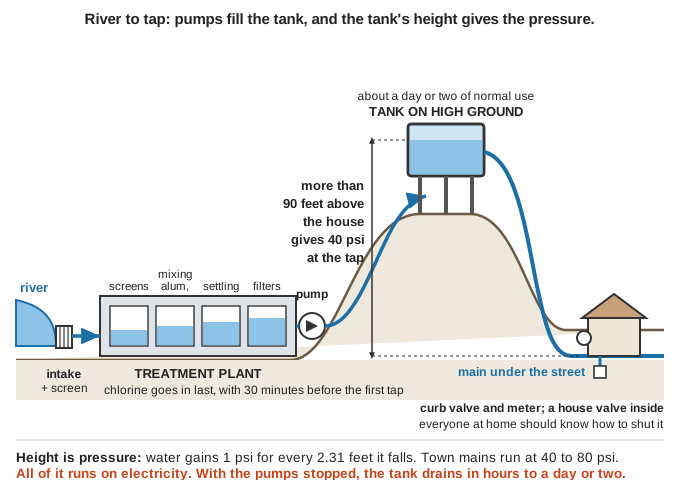 The first half of the loop: intake, plant, tank, main and your own service line. Height is pressure — 1 psi for every 2.31 ft it falls (Texas Rainwater Harvesting, pp. 21–22; WHO/WEDC, pp. 24–25; a diagram drawn for this guide).
Where a town's water comes from
Cities usually take water from rivers, lakes and reservoirs; country towns often use wells (EMP Commission, p. 157; water supply network).
| Source | Good | Trouble |
|---|---|---|
| River or creek intake | Plenty of water, quick to set up | Needs the most treatment (Sphere, p. 131); towns, farms and erosion upstream foul it (WHO/WEDC, p. 24) |
| Wells | Groundwater needs less treatment (Sphere, p. 131) | Need pumps, so power (EMP Commission, p. 161) |
| Springs above town | Gravity carries it: no pump at all (Sphere, p. 131) | Rarely big enough for a whole town (rule of thumb); protect it (Water Wells guide) |
| Infiltration gallery | Perforated pipe buried in gravel beside or under a river, so the riverbed filters the water (rule of thumb) | Silts up in time (rule of thumb) |
Let the riverbed filter it. Water drawn through a river's own sand into a collecting well went from over 400 turbidity units (very muddy) to under 5 in one Indian village (IRC Slow Sand Filtration, p. 21). Dams, weirs and ditches are in the Dams, Weirs, Ditches & Ponds guide.
Cave Junction's water comes from the Illinois River, through a raw-water intake on Highway 199, and from the Daisy Hill Well. It goes through one treatment plant that can treat up to 2 million gallons a day; the city uses only about a third of its water rights (county plan, pp. 108, 124, 129). The town is one pressure zone, fed by four gravity tanks holding 2.8 million gallons and one booster pump station in Kerby, through about 18 miles of pipe up to 18 inches wide (p. 128; map of the system, same page). The tanks are the clearwell at the plant (0.5 million gallons), two on Laurel Road (0.5 and 1.5) and one on South Old Stage Road (0.3) (p. 124). Homes outside the city's pipes depend on their own wells and septic tanks (rule of thumb): see the Water Wells and Sanitation guides.
Treatment, step by step
Most plants do the same steps in the same order (WHO/WEDC, p. 24; the whole plant drawn, p. 25; water treatment):
| Step | What it does |
|---|---|
| Screening | Bar and fine screens catch sticks, leaves and trash (EMP Commission, p. 157) |
| Coagulation | A chemical, usually alum (aluminum sulfate), cancels the charge that keeps mud particles apart, so they stick together (CAWST, p. 11) |
| Flocculation | Slow, gentle mixing grows them into fluffy clumps called floc (EMP Commission, p. 157) |
| Settling | In big, slow tanks the floc sinks as sludge (same page). Done well, these three steps remove 90–99% of germs; done badly, much less. Getting the dose right is a job for trained people (WHO Managing Water in the Home, p. 49) |
| Filtering | A rapid sand filter strains out what is left and must be backwashed regularly (EMP Commission, p. 157); a slow sand filter is a living filter that also cuts germs (WHO/WEDC, p. 25) |
| Disinfection | Chlorine kills what got through, and a little stays in the water to protect it in the pipes (WHO/WEDC, p. 44) |
Chlorine: contact time and residual
- Contact time: at least 30 minutes at 64 °F (18 °C) or warmer, longer in cold water, so chlorine goes in as water enters a tank or a long pipe (WHO/WEDC, p. 43; water chlorination).
- Residual is the chlorine left over; it shows the germs are dead and guards the pipes. Aim for 0.2–0.5 mg/L at the tap, higher near the plant, lower at the far ends (WHO/WEDC, p. 46; Sphere, p. 135). Many people complain at 0.6–1.0 (CAWST Testing, p. 214) and go back to better-tasting, unsafe sources (Sphere, p. 136).
- Clear water first: chlorine misses germs hidden in silt and is weak against Cryptosporidium (WHO/WEDC, p. 43). Get cloudiness below 5 turbidity units first (Sphere, p. 136).
Tanks on the hill, pumps and pressure
Height is pressure: water gains 1 psi for every 2.31 feet it falls, so 40 psi at a house needs a tank more than 90 feet above it (Texas Rainwater Harvesting, pp. 21–22; water tower). Town mains run at 40–80 psi. Low-lift pumps bring raw water into the plant, high-lift pumps push treated water out to the tanks, and booster pumps serve districts higher up (EMP Commission, pp. 157–158). Each tank serves a pressure zone: the houses far enough below it for good pressure (rule of thumb).
The tank covers the gap between steady pumping and use that rises and falls through the day, and holds water for fires and short breakdowns (WHO/WEDC, p. 25). Most hold only a day or two of normal use, because water that sits too long goes stale (county plan, p. 286).
Cave Junction's margin: the city uses between 0.337 and 1.18 million gallons a day (county plan, p. 128), so its 2.8 million gallons of tanks last about 2½ days at the highest use and 8 days at the lowest, if every pipe is sound (arithmetic). A big main break or a large fire empties them much faster. The county warns that where water has to be pumped up to tanks, power outages of more than a day or two may cut off drinking water, and suggests generators, or quick connections for portable ones, at the key pumps (p. 286).
Mains, valves, hydrants and the pipe to your house
| Part | What it is |
|---|---|
| Mains | Big pipes from the tanks, smaller ones along each street (a town's network drawn with its valves, WHO/WEDC p. 16) |
| Stop valves (gate valve) | Closing the ones on each side cuts off one stretch for repair (same page) |
| Washouts | Valves at low points to drain and flush a main (same page) |
| Fire hydrants | For fire engines; crews also use them to fill, flush and test mains (WHO/WEDC, p. 17) |
| Curb valve and meter | In a concrete box at the curb; "extremely difficult to turn" and needs a special tool (Map Your Neighborhood, p. 23) |
| House valve | Where the pipe comes in: garage, basement or by the water heater. Everyone at home should know how to shut it (same page) |
Close valves slowly: stopping fast water all at once sends a hammer blow down the pipe (UNL, p. 3; water hammer).
Backflow and boil-water notices
All pipes leak. When the pressure drops, dirty water enters through the breaks, more than any chlorine people will drink can deal with, so a supply that keeps going off must be treated as contaminated and disinfected where it is used (WHO/WEDC, p. 46; backflow). That is why towns put out a boil-water notice after a main break or a long power cut.
Cross-connections: water can siphon backwards through a hose (OSU Twelve Simple Things, p. 4), so a hose lying in a bucket or stock tank can be sucked into the pipes when pressure drops. Fit backflow preventers (Texas, p. 48; backflow preventer) and keep an air gap between a hose and what it fills (OSU EM9273, p. 2). Mixed drinking and sewage plumbing has caused outbreaks (Ship's Medicine Chest, p. 95).
At home, when mains break or the water is declared unsafe:
- Shut the house valve, or cracked lines may pollute your supply and gravity drain the water heater and toilet tanks (Map Your Neighborhood, p. 23; OSU Water, p. 3).
- Use the water in the house: open the highest tap to let air in and draw from the lowest; drain the water heater with its power or gas off (FEMA, p. 40).
- Treat tap water until it is declared safe (Water Purification guide).
⏳ How long the water lasts after the power fails
The plant stops first: pumps, mixers, screens and filters all run on the grid. A big plant uses so much power that a backup generator is impractical; some systems have generators for a reduced supply for a short time (EMP Commission, pp. 155, 159). Plants are run by computer (SCADA) with few staff: many valves can be worked by hand, but there may not be enough trained people to run a plant by hand for long (pp. 158–159).
Then the tanks drain, in hours to a day or two (county plan, p. 286), faster with leaks, fire hoses and everyone filling bathtubs; houses on the highest ground go dry first (rule of thumb). A blackout over a wide area could stop the water for "weeks or even months" (EMP Commission, p. 156); why is in "Why restarting takes days, weeks or months" in the Power Grid guide.
| What happened (EMP Commission, pp. 160–161) |
|---|
| Montreal, ice storm: both plants for 1.5 million people failed, leaving 4 to 8 hours of water. Officials kept it quiet; people hoarded anyway |
| Fresno, heat-wave blackout: a city on electric wells; only 2 of 16 fire stations had water, and most hydrants were dry |
| Baltimore, hurricane: a sewage plant's three pumps stopped and it spilled 24 million gallons into the harbor |
When the power goes for more than a few hours (rule of thumb): fill every clean container and the bathtub, don't count on hydrants for fires, and plan for no tap water until the plant has power.
After a Cascadia earthquake the Oregon Resilience Plan expects drinking water and sewer to take 1 month to 1 year to restore in its Valley zone and 1 to 3 years in its Coastal zone (Resilience Plan, p. 22). Most of Josephine County is in the Valley zone, parts in the Coastal zone (county plan, p. 39). Old cast-iron pipes snap and newer pipes pull apart at the joints, leaving whole towns with no pressure (Resilience Plan, p. 230), and the leaks drain the tanks and take away fire protection (p. 229).
Keeping a small system going with no grid
In an emergency enough water matters more than perfect water: get the quantity first, then improve the quality (WHO/WEDC, p. 24; Sphere, p. 136).
Let gravity do the work
- Water from above town needs no pump; springs and gravity supplies come first (Sphere, p. 131).
- Water from below town is pumped up once: bring generators to the pumps (WHO/WEDC, p. 24), run them a few hours to fill the tanks, and let gravity deliver ("Pump into storage" and ram pumps in the Water Wells guide).
- If the pipes can't hold pressure, run one sound main to standpipes: one tap per 250 people, no home farther than 500 m (550 yd), no queue over 30 minutes (Sphere, p. 131).
A slow sand filter for a whole town
A slow sand filter is the best single treatment a village can build and run: local materials, no chemicals, a caretaker trained for a short time (IRC, pp. 19–20). Water trickles through fine sand at 0.1–0.3 m (4–12 in) an hour; a slimy living skin, the schmutzdecke, grows on top and eats germs (p. 19). A mature filter removes 95–100% of fecal bacteria and nearly all viruses and cysts (p. 38).
- The box (IRC, pp. 31–34; drawn with every valve, p. 32): watertight concrete, ferrocement, stone or brick, 2.5–3 m (8–10 ft) tall; 1–1.5 m of raw water over 0.8–0.9 m of fine sand (grains 0.15–0.30 mm, no clay or soil; never let it get below 0.5 m), over 0.3–0.5 m of graded gravel and perforated drains. An outlet weir just above the sand keeps it under water.
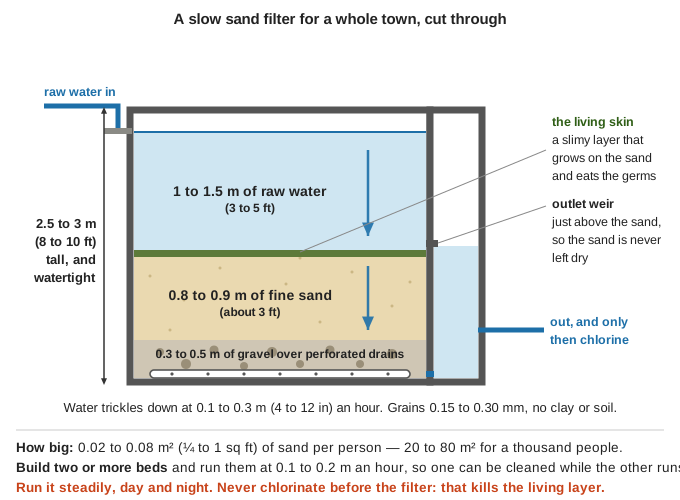 The box, its depths and the living skin on top of the sand (IRC, pp. 19–20, 31–34; a diagram drawn for this guide).
- Size: 0.02–0.08 m² (¼ to 1 sq ft) of sand per person (p. 20), so 20–80 m² (200–900 sq ft) for 1,000 people (arithmetic); a person with one tap uses about 50 litres (13 gallons) a day (p. 46). Build two or more beds, run at 0.1–0.2 m an hour; one may go to 0.3 for a day or two while its partner is cleaned (p. 40).
- Not for muddy water: over 50 turbidity units for weeks, or 100 for days, clogs it. Settle the water first in a pond or gravel roughing filter, or draw it through the riverbed (p. 19).
Running and cleaning it (EPA Slow Sand Filtration, pp. 9–12):
- Run it steadily, day and night; change the flow by no more than half in a day and never switch it on and off, or the living layer starves of oxygen. Keep water above the sand. Below 41 °F (5 °C) filter more slowly, and don't clean it in winter.
- Clean when the water reaches the overflow or the flow falls too low: drain to a few inches below the sand, scrape off half an inch or less with flat shovels, and keep off the uncleaned parts (pp. 10–11). Re-sand before the bed is under 24 inches (p. 11), usually in the second or third year (IRC, p. 34).
- Refill from the bottom, then run it to waste at least a day (an hour for each hour it was off) until tests are good (EPA, p. 12). A new bed takes weeks to months to ripen (p. 7).
- Never chlorinate before the filter: it kills the living layer. Chlorinate what comes out (WHO/WEDC, p. 46).
A homestead-sized filter is in the Water Purification guide.
Chlorinating by hand
Drops per gallon and the pool-shock stock solution are in "Step 3 — Kill the germs" in the Water Purification guide. For a town tank:
- Dose where the water has 30 minutes before the first tap, as it enters the clear-water tank or a long main (WHO/WEDC, p. 43).
- Use bleach or calcium hypochlorite (pool shock), not chlorine gas: pure chlorine is "difficult and dangerous to use" (VITA, p. 133). Make powder into a paste before adding it (WHO/WEDC, p. 46). VITA's table gives amounts per 1,000 gallons: very clear water starts at 5 parts per million, slightly hazy water at 10 (VITA, p. 134).
- A drip feeder with no power: barrels on a shelf feed weak bleach and raw water side by side at the same steady pressure into the town's tank. Start with ½ pint of bleach in 50 gallons of water for each 500 gallons treated, and adjust until the tank water has a noticeable chlorine taste (VITA, pp. 137–139; the barrels, p. 138).
Testing the residual (WHO/WEDC, pp. 44–45; the steps drawn, p. 45): a DPD tablet turns a sample red, and you match it against a color chart (stock tablets now (rule of thumb)). Test where the chlorine goes in, at the nearest house and at the far ends of town; daily for a new or repaired system, then at least weekly. With no kit, a faint chlorine smell after 30 minutes means enough was added (Water Purification guide). If the supply keeps going off, chlorinating the pipes is pointless: have people disinfect at home (WHO/WEDC, p. 46), and keep scarce chemicals for places like the hospital and schools (p. 26).
Finding and fixing leaks
WHO's steps for a small town's broken pipes (WHO/WEDC, pp. 15–18):
- Map the damage with the staff who know the system and its drawings; walk the network and mark every break.
- Tell people what is off, what you're doing and when, and how to stay safe.
- Give them other water if repairs will take more than a few hours: tankers, and advice on local springs and wells for washing.
- Isolate the break with the valves, so the rest of town keeps water. If the valves can't be found, fit new ones.
- Repair from the source outward, 500–1,000 m (⅓–⅔ mile) between valves at a time, with repair clamps or a new pipe laid on the ground for now. Shore the trench, keep traffic away, and find other buried lines first (shoring, a clamp and backfill, p. 17).
- Test, flush and disinfect: hold 1½ times normal pressure for 4 hours and watch the joints; flush until clean; fill with water dosed at 80 g of calcium hypochlorite per 1,000 litres (about 11 oz per 1,000 gallons (arithmetic)) for 24 hours; flush until the strong chlorine smell is gone (pp. 17–18).
Hidden leaks (rule of thumb): a wet or green strip in dry weather, water in a valve box, a hiss heard through a steel rod on a valve at night, a tank that drops at night when nobody uses water. People help find leaks if you ask (WHO/WEDC, p. 26).
Protecting the source
Keeping the water clean is the cheapest treatment: manage excreta, garbage and storm runoff, control erosion and farm runoff, and keep people out of the source; getting the town's sewage under control may matter more than repairing the water plant (WHO/WEDC, p. 24; what to keep away, same page). Walk the source regularly and check drainage, fences, latrines and garbage, and test any new source for arsenic and fluoride as well as germs (Sphere, pp. 135–136). Latrines and graves stay 100 ft from water (Sanitation guide); fence the intake, filters and tanks and lock the hatches (rule of thumb).
What to tell everyone
Tell people what is affected, what you are doing and when, and what they should do, and keep the updates coming (WHO/WEDC, p. 15); news eases worry, cuts waste and gets leaks reported (p. 26). Secrecy fails: Montreal's silence didn't stop hoarding, and boil-water warnings meant nothing to people with no way to boil (EMP Commission, pp. 160–161). A notice that works (rule of thumb): is the water safe, boil, or off; where the nearest safe water is; don't flush if the sewer is down; when the next notice comes. Post it in the same places daily and send it by runner ("Runners, relays and written messages" in the Signals & Morse guide).
Sewers: from drain to river
Gravity sewers, slope and manholes
A sanitary sewer is a branching network of pipes running downhill to the plant (Compendium, pp. 92–93; drawn, p. 92):
- It slopes all the way, fast enough to scour itself: about 2 ft (0.6–0.7 m) a second. Where the slope can't be kept, a pumping station lifts the sewage. Main sewers lie 5–10 ft (1.5–3 m) under the roads.
- Manholes sit at set distances and at every junction and bend, for inspection and cleaning.
- Sewers need water: keeping that speed takes over 100 litres (26 gallons) a person a day. With water rationed, solids settle and pipes block (rule of thumb).
- Grease, rags and grit block them; crews rod, flush, jet and bail them. Sewers "can be dangerous because of toxic gases" and are work for trained crews (p. 93).
Lift stations: when the pumps stop
A lift station (pumping station) is a deep pit, the wet well, where sewage collects until pumps lift it to a higher sewer (Compendium, p. 92). When its power fails, the wet well and the sewers behind it fill, sewage comes up the lowest drains first (basement floor drains, low toilets and showers), and then out of manholes into streets and creeks (rule of thumb) (sewer overflow). A generator or engine pump at each key lift station keeps the sewer working (rule of thumb). Nobody goes down into the wet well ("Deadly dangers", below).
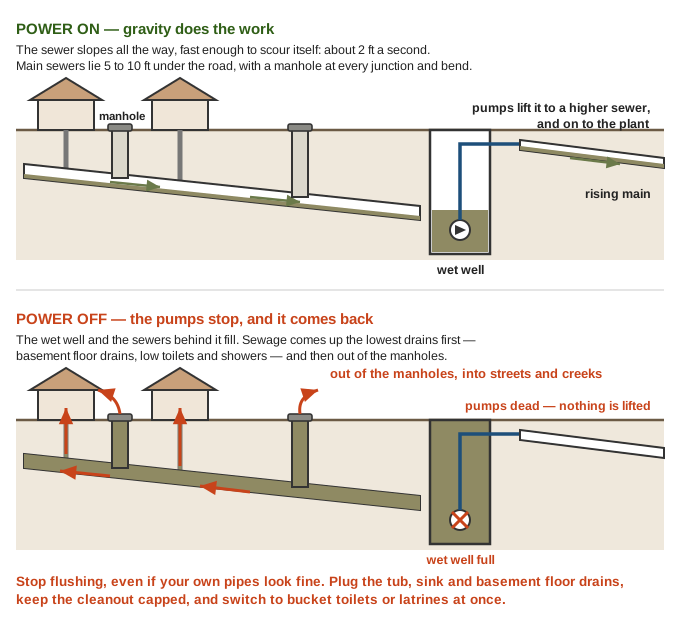 A gravity sewer and its lift station, working and with the power off (Compendium, pp. 92–93; OSU Sanitation, p. 5; a diagram drawn for this guide).
The treatment plant
A plant cleans sewage in stages (EMP Commission, p. 158; sewage treatment):
| Stage | What it does |
|---|---|
| Screens and grit chambers | Catch rags, sticks and sand that wreck pumps; automatic screens need power (Compendium, pp. 100–101) |
| Primary settling | Most solids sink as raw sludge, which goes to a digester |
| Biological treatment | Bacteria eat what is dissolved. Activated sludge blows air through tanks and needs constant electricity and skilled staff; its bacteria take weeks to grow back (Compendium, pp. 126–127). A trickling filter sprays settled sewage over stones coated in slime that eats it (p. 114) |
| Final settling and disinfection | The bacteria settle out; then chlorine, ultraviolet lamps, or sunlight in shallow ponds (Compendium, pp. 128–129) |
Lagoons (waste stabilization ponds) need no electricity: three or more ponds in a row, a deep anaerobic pond (2–5 m, 1–7 days) that settles and digests the solids, a facultative pond (1–2.5 m, 5–30 days), and shallow maturation ponds (0.5–1.5 m) where sunlight kills germs. They cost little to run and take sudden loads, but need a lot of land. Fence them, skim the scum, pull water plants that breed mosquitoes, and dig out the first pond every 2–5 years, when it is a third full of sludge (Compendium, pp. 110–111).
Cave Junction's sewage plant treats and disinfects the town's wastewater to the limits in its discharge permit (county plan, p. 108). It was on the county's list of places to study for a solar-and-battery microgrid (p. 288). The county warns that sewage plants and lift stations stop when the power fails, with overflows, and that treatment plants often sit low in floodplains (p. 286); the city rates its chance of a river flood as high (p. 133).
Sludge
Sludge is the solids a plant collects; raw sludge goes to a digester, where bacteria break it down without air (EMP Commission, p. 158; anaerobic digestion). On drying beds of sand and gravel over drains, 50–80% of the liquid drains or dries off and the cake can be shoveled out after 10–15 days; roof them in a wet climate. Dried sludge is not safe yet, and the water draining off needs treating too (Compendium, pp. 118–119). "Even after treatment, sludge is rarely pathogen-free": wear boots, gloves and a mask, and follow the rules on which crops may get it (p. 139); keep it off anything eaten raw (rule of thumb).
Storm drains and combined sewers
Storm drains carry rain from the streets straight to a river or lake. No toilet may be connected to one; clear them of trash before the rainy season (Compendium, pp. 94–95). Combined sewers carry rain and sewage in one pipe and overflow on purpose in storms so the plant isn't swamped; they are no longer thought good practice (p. 93). Rain gets into separate sewers too, through manholes and cracked pipes (pp. 92–93), so a sewer near its limit backs up in heavy rain (rule of thumb).
When the town's sewer fails
- Stop flushing, even if your pipes look fine: the street's may be broken. A septic tank can keep working if nothing leaks or backs up (OSU Sanitation, p. 5).
- Keep sewage out of the house. Plug the tub and sink drains (OSU Water, p. 3). Sewer pipes let water into a building unless they have backflow devices (FEMA P-1019, p. 110). Plug basement floor drains with a rubber test plug, or a towel under a bag of sand; keep the cleanout capped; a backwater valve (a flap that lets sewage out but not back) is the lasting fix (rule of thumb).
- Keep the traps wet in drains still used for wash water, or sewer gas comes in (rule of thumb).
- Switch to bucket toilets and latrines at once, with handwashing by each; wash water to a soak pit (Sanitation guide). Never tip buckets into manholes or storm drains (rule of thumb).
- Treat sewage on the ground as an outbreak waiting to happen: fence it off, cover it, keep children and animals away ("How germs spread, and stopping an outbreak" in the Sanitation guide).
After a Cascadia earthquake the Oregon Resilience Plan expects that in many places it would take a year before the sewers work again and three years for the main lines and plants. Meanwhile the rivers fill with raw sewage, the water plants downstream struggle, and people turn to chemical toilets and latrines (Resilience Plan, p. 238).
☠️ Deadly dangers
Manholes, wet wells, vaults and tanks: never go in
Sewers, wet wells, valve vaults, septic tanks and closed tanks can hold air that kills (confined space; sewer gas):
- Hydrogen sulfide smells of rotten eggs at low levels, but the sense of smell quickly fails at higher ones, and it causes "rapid incapacitation" (NWCG IRPG, p. 42). It paralyzes breathing: "Victims become unconscious and never regain consciousness." Never use your nose to judge it (FM 10-67-1, p. 241).
- No oxygen: rust in a long-closed tank uses it up (same page). Safe entry needs a meter reading of 19.5–23.5% oxygen and no flammable gas (UFM 3-460-03, p. 408).
- Explosive gas: a flame can set it off (Hospital Corpsman, p. 128); test before opening a manhole and use only gas-proof lights (FM 5-424, p. 169).
People die going in to rescue someone: "In a large number of accidents, the rescuer rushes in and becomes the second victim." A wet cloth gives "no protection against poisonous gases or lack of oxygen," and a gas mask makes no oxygen (Hospital Corpsman, pp. 128, 130).
- Never enter. Not for a minute, not for a tool, not for a person or a dog.
- If someone collapses inside, call for help and lower a rope, or a hose blowing fresh air (rule of thumb). Only crews with gas meters, their own air, a harness and a lifeline tended from outside go in, and they follow the lifeline rather than drag the victim (Hospital Corpsman, pp. 127–130).
- Keep lids on; guard an open manhole with a flag by day and a barricade by night (FM 5-424, pp. 169–170). Septic tanks, pits and wells: the same rule.
Chlorine
- Breathing chlorine fumes must be avoided (WHO/WEDC, p. 43). Big plants use chlorine gas (p. 25), which is hard to handle and store safely (Compendium, p. 129; chlorine gas poisoning). If a chlorine room smells sharp or you see yellow-green gas, get out uphill and upwind and stay out (rule of thumb).
- Never mix bleach with ammonia, acids or urine: it releases toxic chlorine gas, "especially in a confined space" (WHO-PAHO, p. 76).
- Store pool shock cool, dry and sealed, away from fuel, oil and anything that burns (rule of thumb).
Sewage, trenches and traffic
- Sewage spreads hepatitis, cholera and typhoid (Hesperian Ch 7, p. 15); disposing of it properly is one of the most important ways to stop them (Hospital Corpsman, p. 335). Wear boots, gloves and protective clothing (Compendium, pp. 101, 119), cover cuts, and wash before eating (rule of thumb).
- Trench walls fall without warning (rule of thumb). Shore loose ground (WHO/WEDC, p. 17; trench shoring), cut the sides of any trench deeper than 5 ft back at about 45° (DOE Microhydropower Handbook, p. 107), pile the dirt well back from the edge (Peace Corps Wells, p. 53), find other buried lines first (WHO/WEDC, p. 17), and never dig alone (rule of thumb).
- Traffic: route it away from the work (WHO/WEDC, p. 17), put out cones and wear an orange vest (EPA Sumps, p. 5), and post a flagger (FM 5-424, p. 169).
Who runs it, and the records to get now
The people matter as much as the pipes. Repairs start with the local staff who know the system and its drawings (WHO/WEDC, p. 15). Operators may not fully understand the treatment process, so find the engineers too, and pay them if their pay has stopped (p. 23). Computer control has cut staff below what long running by hand would take (EMP Commission, p. 159).
Records to ask for now, on paper (rule of thumb):
- System map: mains and sizes, tanks, pumps, pressure zones, hydrants and washouts.
- Valve list: where each valve is, its size, turns to close, which way it turns, and what it shuts off. It turns hours of searching into minutes.
- Sewer map: manholes, depths and lift stations, to know where sewage will back up.
- Power needs of each pump and plant, and the generator hookups.
- Chemicals: stock and suppliers of alum, chlorine and test tablets, which run out first.
- The plant's operating steps, so someone else can run it.
Why ask now: in a disaster the staff may be busy, hurt or gone, and the maps on a computer with no power (rule of thumb). If the utility keeps full maps private for security, ask for the valves on your own streets, or for an operator to walk them with you (rule of thumb). Know your house valve and curb box (Map Your Neighborhood, p. 23) and put the valves on the neighborhood map ("Skills, tools and the neighborhood map" in the Community guide).
Who to ask here: the City of Cave Junction runs both the water plant and the sewage plant (county plan, p. 108). Its Water Master Plan (2013) and Water Distribution Master Plan hold the maps and the maintenance plans, and the master plan includes steps for conserving and rationing water (pp. 128–129). Ask City Hall for copies, and for the valves on your street.
⚠️ Old advice in the library to ignore
| Book says | Do this instead |
|---|---|
| "To determine the presence of harmful gases, a lighted candle or small bird should be lowered into the well" (USDA FB 1448, p. 20); test a tank "by burning a candle on the bottom" (Bluejackets' Manual, p. 215) | A flame says nothing about hydrogen sulfide, which kills at levels far too low to put a candle out (rule of thumb), and it can set off gas (Hospital Corpsman, p. 128). Use a gas meter, or don't go in |
| "To rescue an unconscious person in a place filled with gas, move quickly and carry him out without breathing yourself"; "less gas will be found near the floor" (Boy Scouts Handbook 1911, p. 288) | That is how rescuers die (Hospital Corpsman, p. 128); deadly gases are "just as likely" near the floor (p. 129). Call for help and work from outside |
| Oxygen: "A concentration of less than 7 percent is dangerous" (FM 10-67-1, p. 241) | Under 19.5% is unsafe to enter without your own air (UFM 3-460-03, p. 408; Ship's Medicine Chest, p. 197) |
| Carry the drainpipes "to any running stream where the water is not afterwards used" (Household Discoveries, p. 103) | Someone downstream always uses it (Hesperian Ch 7, p. 15). Treat sewage, or use latrines 100 ft from water (Sanitation guide) |
| Test chlorine with "orthotolidine" (VITA, p. 135) | Use DPD tablets and a comparator (WHO/WEDC, p. 44) |
Pictures & diagrams
Look before you try it. 🖼️ = drawings in the books on this drive; the other links are photos in the offline Wikipedia.
Town water
- A whole plant, intake to storage, and rebuilding one in stages — WHO/WEDC, pp. 25–26; what to keep away from the source — p. 24; Water treatment; Clarifier
- Drawing water through a riverbed, and a filter fed that way — IRC, p. 21; p. 42; Infiltration gallery
- Slow sand filters with all their valves, and village plants with plans — IRC, pp. 32–33; pp. 93–100; Slow sand filter; Schmutzdecke
- A barrel drip chlorinator, and a settling basin with a sand filter — VITA, p. 138; p. 141; testing chlorine with a comparator — WHO/WEDC, p. 45; Water chlorination
- A town's mains with valves, washouts and hydrants, the damage marked — WHO/WEDC, p. 16; shoring, a pipe clamp, backfill — p. 17; the house water valve — Map Your Neighborhood, p. 23; Water tower; Fire hydrant; Backflow prevention device
Sewers and treatment
- A gravity sewer and manhole, a shallow "simplified" sewer, storm drains — Compendium, p. 92; p. 90; p. 94; Sanitary sewer; Manhole; Combined sewer
- Screens and grit removal; lagoons in series — Compendium, p. 100; p. 110; Waste stabilization pond
- A trickling filter, activated sludge, a chlorine contact tank, drying beds — Compendium, pp. 114, 126, 128, 118; Activated sludge; Sewage treatment
Safety
- A rescue lifeline — Hospital Corpsman, p. 128; guarding an open manhole at night — FM 5-424, p. 170; Confined space; Hydrogen sulfide
- Tanks, pipes and plants broken by other great earthquakes — Resilience Plan, pp. 230–238; Cave Junction's water service area and pipes — county plan, p. 128
Related guides
- Water Wells and Water Purification — one household's water, pumping into storage, boiling and bleach
- Sanitation — septic tanks with no power, latrines, bucket toilets, stopping an outbreak
- Dams, Weirs, Ditches & Ponds — holding and leading water
- How the Power Grid Works — why the power, and so the pumps, can be out for weeks
- Engines, Motors and Generators and Fuel — running pumps on a generator
- Floods, Ice Storms & Heat Waves — flooded wells and septic tanks, frozen pipes
- Community & Barter — a neighborhood group and its map
- Illinois Valley — Start Here — local contacts and maps