Guides › Making & repair · Emergency · Index A–Z
Knots, Rope & Cordage
The dozen or so knots that do nearly every job, step by step, and the rope itself: what it can hold, what weakens it, keeping it sound, lifting with blocks and tackle, and making cord. The Army's rigging manual (FM 5-125) and survival manual (FM 3-05.70) are in Manuals\ArmyFieldManuals; the USDA's Rope on the Farm (1964) in Southern-Oregon\Homestead-Skills\Food-Crafts-Tools; Military Mountaineering (TC 3-97.61) and Kephart's Camping and Woodcraft in Southern-Oregon\Travel-On-Foot; the Air Force survival handbook (AFH 10-644) and the 1911 Scout handbook in Southern-Oregon\Comms-Signals\Visual-Sound-Signals; picket lines and pack hitches (FM 25-7) in Southern-Oregon\Horses-Draft-Animals\Packing-Travel.
The short version
- Learn a few knots well. "It is better to learn a few knots perfectly" than a long list (Bluejackets' Manual, p. 258).
- The square knot is for bundles, not loads: it "will not hold if the ropes are wet or if they are of different sizes" (FM 5-125, p. 46). Join ropes with a sheet bend.
- Every knot weakens rope. A splice keeps 80–90% of its strength, a knot 50–60% (Rope on the Farm, p. 6).
- Load rope to a quarter of its breaking strength or less. Fiber rope, rule of thumb: safe load in tons = (diameter in inches)², so ½ inch carries ¼ ton (FM 5-125, p. 20).
- Don't trust rope you can't vouch for: "A rope of unknown history or construction should not be used for any application" (TC 3-97.61, p. 170).
- Stay out of its way. Never stand in a loop of loaded rope (rule of thumb), never wrap rope round your hand (4-H PNW 587, p. 51), and never hold a hanging load by hand alone — take a turn round a post (Mounted Instruction, p. 222).
- Round an animal's neck, only a bowline (same 4-H page).
- Store rope dry, off the ground, out of the sun (Rope on the Farm, pp. 12, 14).
Which knot for which job
| The job | The knot |
|---|---|
| Tie a bundle, a sack, a bandage (never a load) | Square knot |
| A loop that won't slip: round a post, a person, an animal's neck | Bowline |
| Join two ropes, even of different sizes or wet | Sheet bend |
| Quick tie to a post; start a lashing | Clove hitch |
| Tie off to a tree or ring under load and leave it | Round turn and two half hitches |
| A tent or guy line you can tighten later | Taut-line hitch |
| Cinch a load down; stretch a picket line | Trucker's hitch |
| Drag or lift a log or pole | Timber hitch plus a half hitch |
| Stop an end slipping through; the strongest fixed loop | Figure eight |
| Grip another rope; hold what you've hauled | Prusik |
| Poles crosswise; an A-frame | Square and shear lashings |
| Stop fraying; join or make an eye for good | Whipping and splices |
| Tie up a horse or cow | Quick-release knot |
Rope words (FM 5-125, pp. 41–42): the standing part is the long, idle part; the running end is the end you tie with; a bight is a U-bend; a loop crosses itself; a turn goes once round a post; a round turn goes round and a half.
The knots, step by step
Practise with rope at least ⅛ inch thick, not string (Kephart, p. 275). Dress every knot — parts lying neatly side by side, slack pulled out. A sloppy knot can lose another 50% of its strength (FM 3-05.70, p. 640).
Square knot: bundles, not loads
For two ends of the same size where nothing hangs on it (AFH 10-644, p. 262; square, granny and thief knots; Square knot):
- Cross the right end over the left and tuck it under.
- Cross the left end over the right and tuck it under.
- Check: each end lies beside its own standing part. If not, it's a granny, which "will slip under strain".
- To untie, push the two bends toward each other.
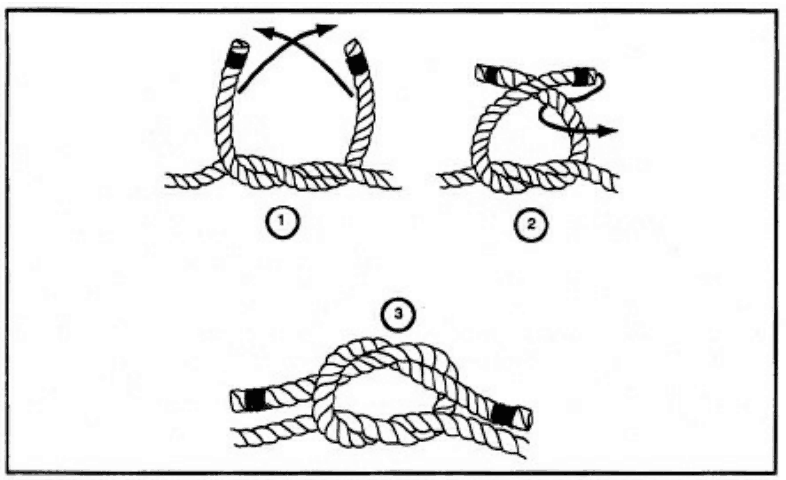 Right over left and under, then left over right and under (FM 5-125, p. 48).
On a rope that matters, tie an overhand knot in each tail — and use it only "when it is impossible to tie a more secure joining knot" (TC 3-97.61, p. 189; with safety knots).
Bowline: a loop that won't slip or jam
"The best knot for forming a single loop that will not tighten or slip under strain" (FM 5-125, p. 49; drawing; Bowline).
- Leave enough end for the loop. On the standing part make a small loop, the end side lying on top.
- Bring the end up through the small loop,
- round behind the standing part,
- and back down through the small loop, beside itself.
- Hold the end against the big loop and pull the standing part to set it (AFH 10-644, pp. 264–265; Kephart, p. 286).
- Back it up with an overhand knot in the tail round the loop's side, leaving about 4 inches (TC 3-97.61, p. 191; drawing).
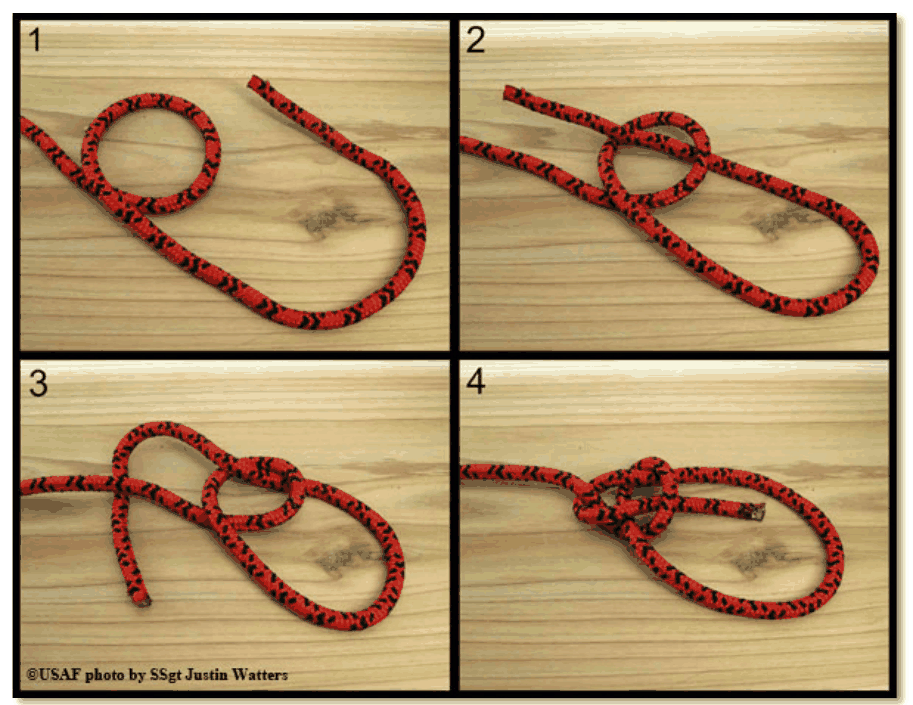 Steps 1 to 4: up through the small loop, round behind, back down (AFH 10-644, p. 265).
It unties easily even after a heavy pull. For lifting a person, use a figure-eight loop (below).
Sheet bend: joining two ropes
(FM 5-125, p. 47; single and double; Sheet bend)
- Bend the thicker rope into a U.
- Pass the thinner rope's end up through the U,
- round behind both legs of the U,
- and under itself (not under the U). Pull snug (AFH 10-644, p. 263).
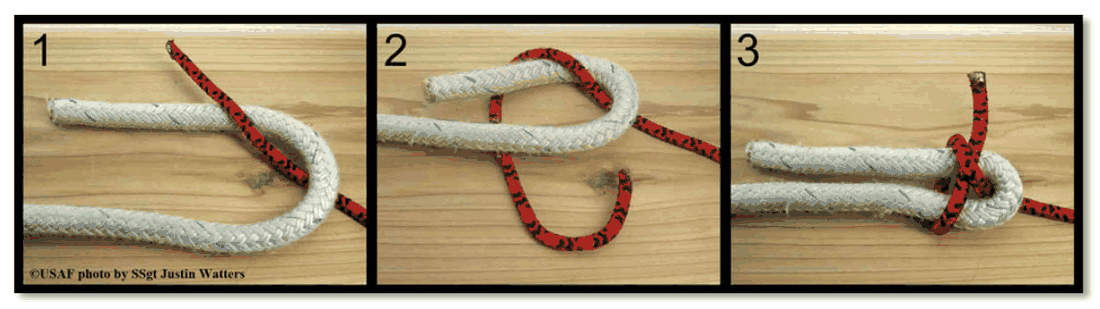 The thin rope goes up through the thick one's U, round behind it, and under itself (AFH 10-644, p. 264).
It can loosen when slack. For wet rope or heavy loads take the thin end round a second time before tucking: the double sheet bend "will not slip or draw tight under heavy loads" (AFH 10-644, p. 264).
Clove hitch: quick tie to a post
(FM 5-125, p. 61; drawing; end of a rope; Clove hitch)
- Round a pole: take the end round once, crossing over the standing part; round again the same way; tuck the end under that second turn. End and standing part leave on opposite sides (AFH 10-644, p. 268; Kephart, p. 283).
- Over a post top: twist two loops the same way, lay the second behind the first, drop both over the post (Kephart, p. 282).
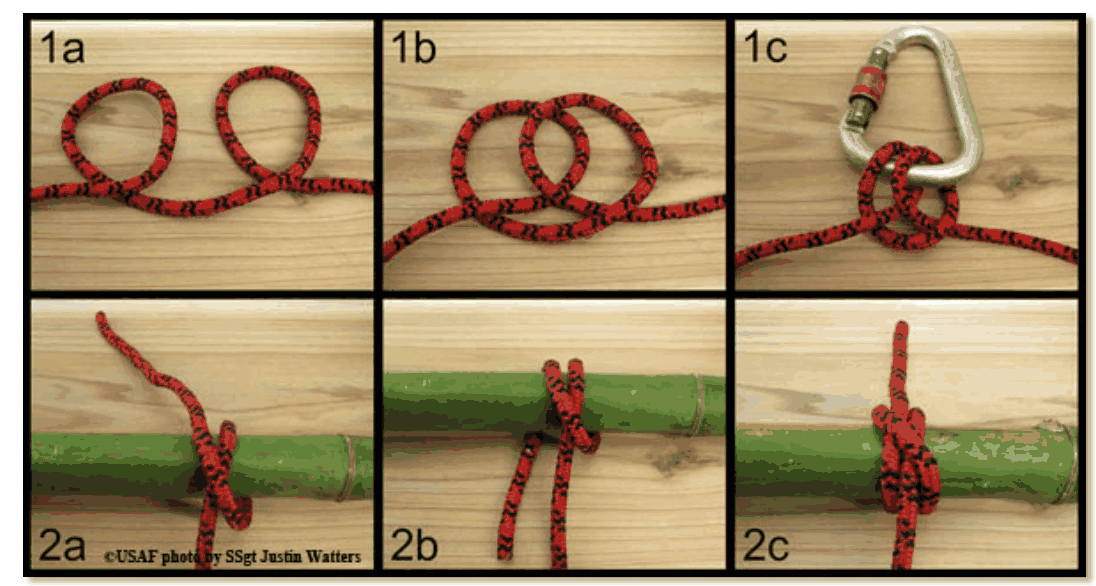 Top row: over a post top. Bottom row: round a pole (AFH 10-644, p. 269).
It slips when the pull comes and goes: "tension must remain on the knot or it will slip" (FM 3-05.70, p. 643). Add a half hitch round the standing part.
Two half hitches and the round turn
Two half hitches: pass the end round the post, round the standing part and back under itself; do it again beside the first (AFH 10-644, p. 269; drawing).
Round turn and two half hitches — for a real load. It "does not jam" (FM 5-125, p. 60); it is the Army's "main anchor knot" where "high loads would make other knots jam" (FM 3-05.70, p. 642; Round turn and two half-hitches):
- Take the end round the post twice. These turns take the strain.
- Tie two half hitches round the standing part. Seize the tail to it for more security (AFH 10-644, p. 269).
Taut-line hitch: a line you can tighten
No book here draws it. It is a rolling hitch tied round the rope's own standing part, and a rolling hitch "grips tightly but is easily moved along a rope or pole when the strain is relieved" (FM 5-125, p. 61; rolling hitch; Taut-line hitch). Steps (rule of thumb):
- Pass the end round the stake or through the grommet.
- Wrap it twice round the standing part, working back toward the stake, inside the loop.
- Then one half hitch round the standing part, beyond those two wraps (away from the stake).
- Snug it. Slide the knot to tighten or slacken; under load it holds.
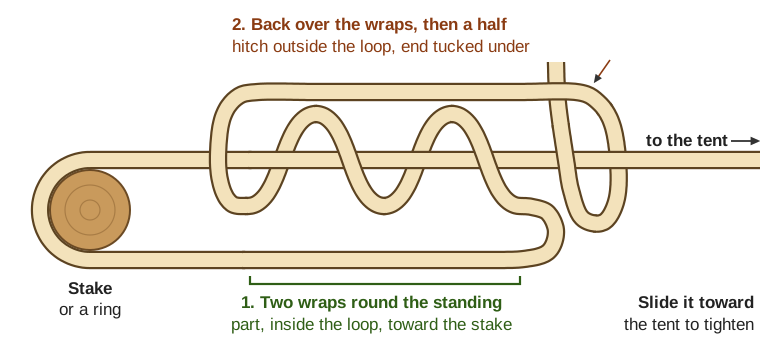 Two wraps inside the loop, one half hitch outside; drawn loose so the rope's path shows (a diagram drawn for this guide).
Slacken guy lines before rain: wet rope shrinks "and may break" (FM 5-125, p. 21).
Trucker's hitch: pulling a load down tight
The Army's pack manual stretches picket lines with it (a "pullback"), giving "a two-to-one mechanical advantage" (FM 25-7, p. 156); the Air Force ties packs with it (AFH 10-644, p. 451; Trucker's hitch).
- Tie one end to the load or the far anchor.
- A few feet short of the near anchor, make a fixed loop in the standing part. FM 25-7 uses a sheepshank (sheepshank); a figure-eight loop works too (rule of thumb).
- Pass the end round the near anchor (hook, ring, stake) and back through the loop.
- Pull it back toward the anchor.
- Pinch it at the loop and tie off with two half hitches, or a slipped half hitch "directly behind the pullback" that one tug releases (FM 25-7, p. 156).
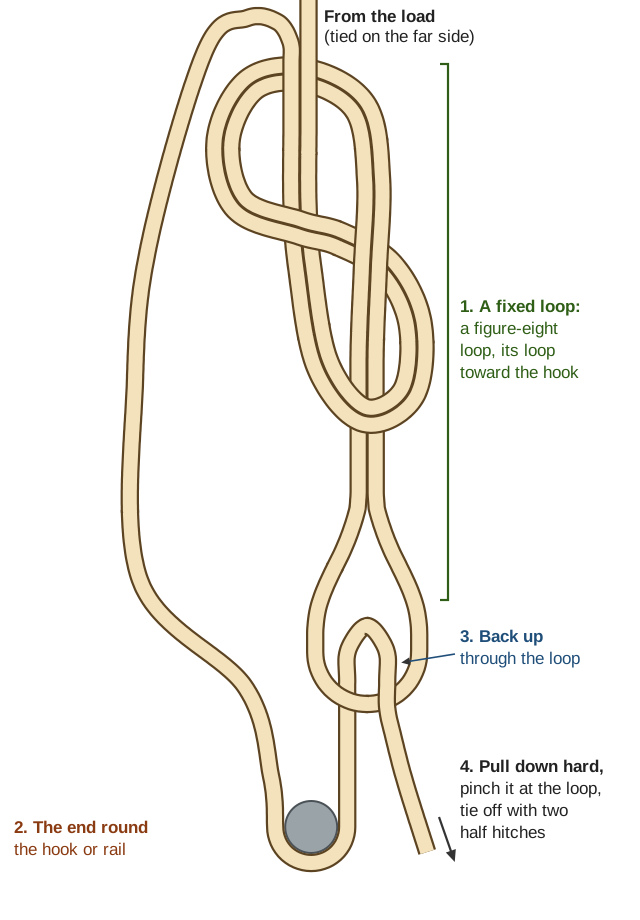 A figure-eight loop, the end round the hook and back up through the loop; pull, pinch and tie off (a diagram drawn for this guide).
The rope rubs on itself in the loop: don't lift loads with it (rule of thumb).
Timber hitch: dragging logs and poles
"The more tension applied, the tighter the hitch becomes"; it loosens when the strain comes off (FM 5-125, p. 60; drawing; Timber hitch).
- Pass the end round the log and round the standing part.
- Twist it round itself three or more times. The twists must go round the end's own part "or the knot will not tighten against the pull" (AFH 10-644, p. 268).
- To drag or lift, add a half hitch farther along the log toward the pulling end: it takes the strain, and the timber hitch keeps it from slipping (same page). Alone, a timber hitch "may become untied when the rope is slack or when a sudden strain is put on it" (FM 5-125, p. 60).
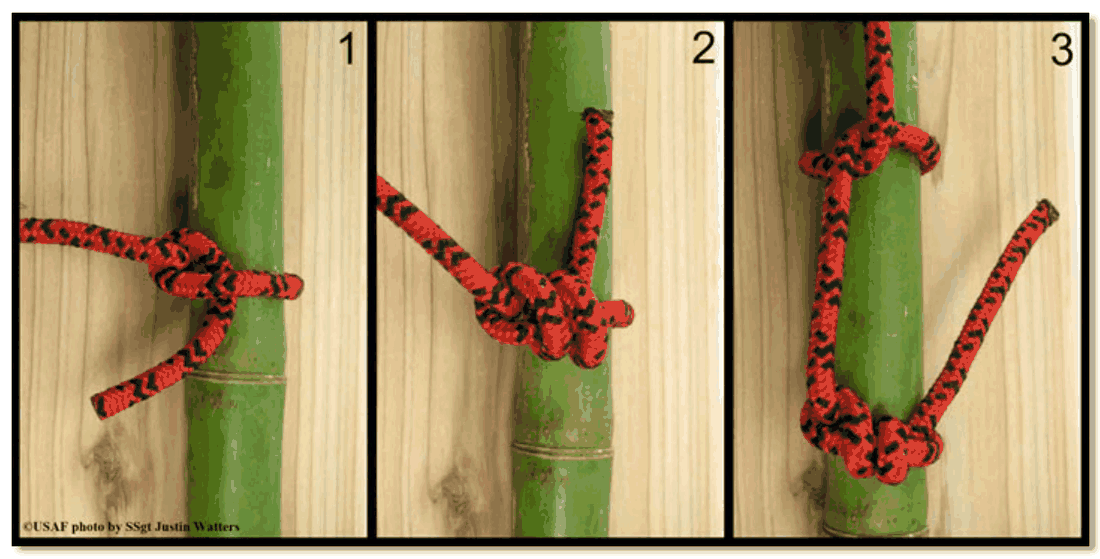 A half hitch, a timber hitch, and the two together for dragging or lifting (AFH 10-644, p. 268).
Figure eight: the stopper and the loop
Stopper: make a loop in the standing part, take the end round behind the standing part and back down through the loop (AFH 10-644, p. 262; drawing; Figure-eight knot). It stops an end slipping through a pulley or ring and is easy to untie (FM 5-125, p. 45).
Figure-eight loop: "the main rescue knot in use today", stronger than the bowline and easier to check, though harder to untie when wet after a load (FM 3-05.70, p. 647). Double the rope into a bight as long as the loop, tie a figure eight with it, and check the two ropes run side by side without crossing (TC 3-97.61, p. 180; drawing). To tie it round a tree, tie a loose single eight, pass the end round, and trace it back through (retraced).
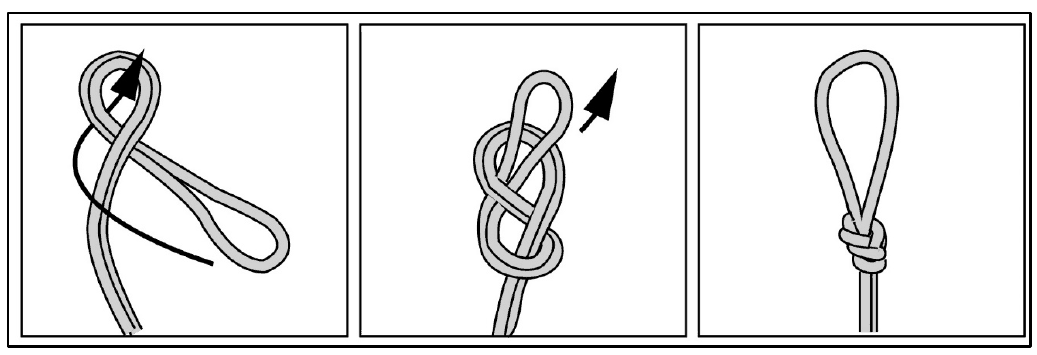 The figure-eight loop tied in a doubled rope (TC 3-97.61, p. 180).
Prusik: a grip that slides, then holds
It "will slide ... if no tension is applied, and will hold if tension is applied" (FM 3-05.70, p. 645; Prusik): a handhold or foot loop on a fixed rope, or a catch that holds a hauled load while you reset.
- The cord: about 6 ft (1.8 m) tied into a loop with a double fisherman's knot (TC 3-97.61, p. 170), about 3 mm thinner than the main rope (p. 194).
- Lay the loop behind the main rope. Pass the far end through the near end, round the rope, three times, each wrap inside the last.
- Dress it: six neat, parallel wraps with one bar across them (p. 196; drawing).
- Test that it grips before you load it (p. 194).
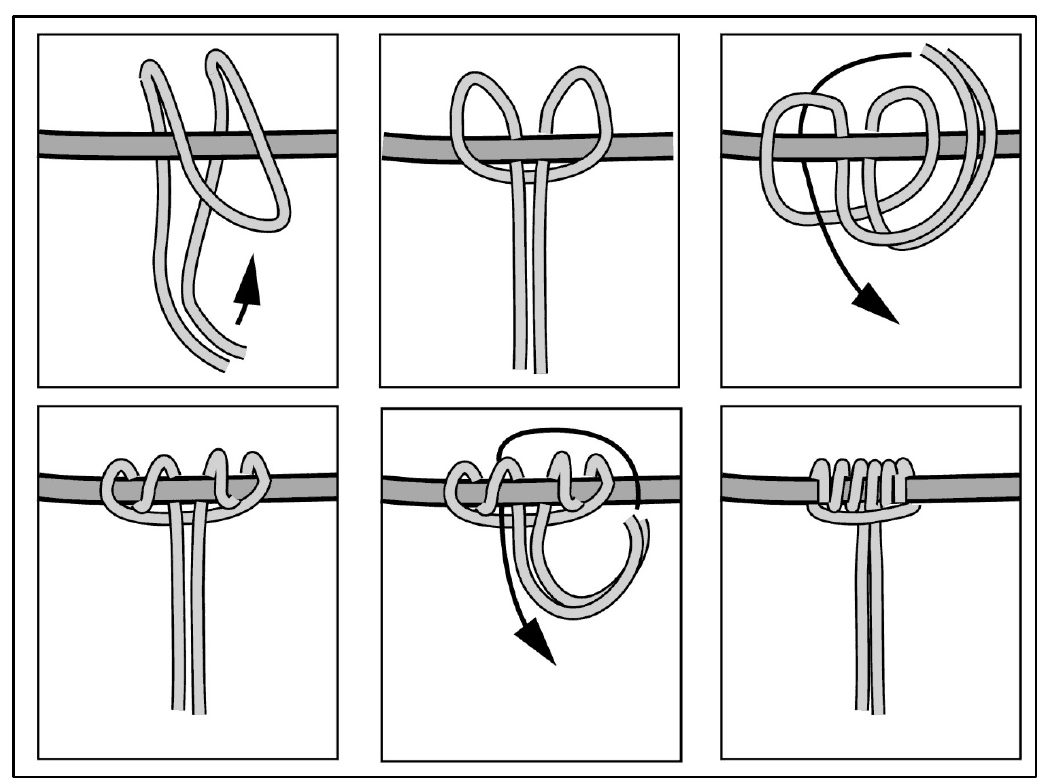 Six neat wraps and one bar across them (TC 3-97.61, p. 195).
Lashing poles together
Lashings start and end with clove hitches; frapping turns, wound between the poles round the wraps, pull everything tight (FM 3-05.70, p. 640; Lashing).
Square lashing
(FM 5-125, p. 67; drawing; AFH)
- Clove hitch on the upright, just below the crosspiece.
- Wrap over the crosspiece, behind the upright, over the crosspiece's other side, behind the upright. Each turn lies outside the last on the crosspiece and inside it on the upright (AFH 10-644, p. 271).
- At least four tight turns (FM 5-125, p. 67).
- Two or three frapping turns, pulled hard.
- Finish with a clove hitch (FM 5-125 puts it on the other pole, AFH 10-644 on the first; either holds if tight).
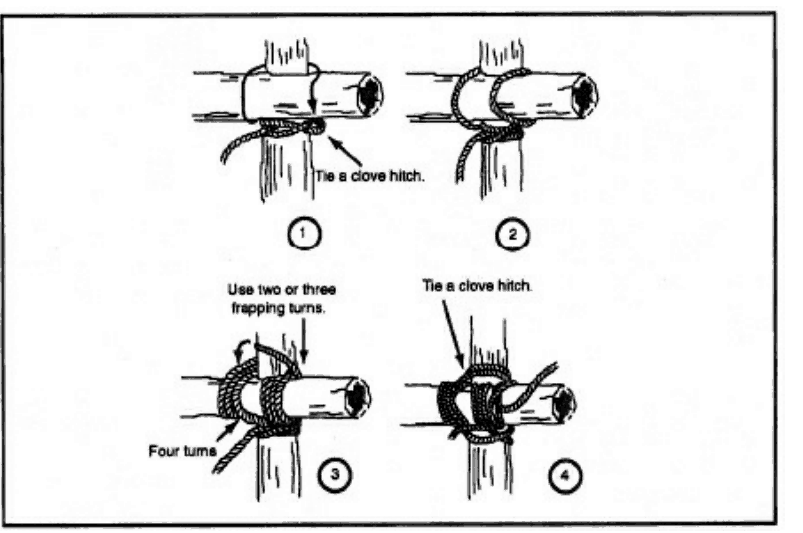 Clove hitch, four turns, frapping turns, clove hitch (FM 5-125, p. 68).
Shear lashing
For an A-frame to lift or hang things (FM 5-125, p. 67; drawing):
- Two poles side by side, butts together, a third of a pole's thickness apart.
- Clove hitch on one pole a little below the top; eight tight turns round both.
- At least two frapping turns between the poles; clove hitch on the other pole. Spread the butts.
For legs that must spread wide, wind more loosely (Kephart, p. 296). Three poles make a tripod (tripod lashing).
Whipping and splicing
"Use splices instead of knots whenever possible" (Rope on the Farm, p. 6).
Whipping a rope's end
(AFH 10-644, p. 260; drawing; Whipping knot)
- Bend strong twine into a long, narrow U; lay it along the rope, the U poking ½ inch past the rope's end.
- From the inner end, wrap the twine tightly round rope and U, the same way the rope is twisted, to within ½ inch of the end.
- Slip the twine's end through the U. Pull the other end until the U drags it under the wraps. Trim both close.
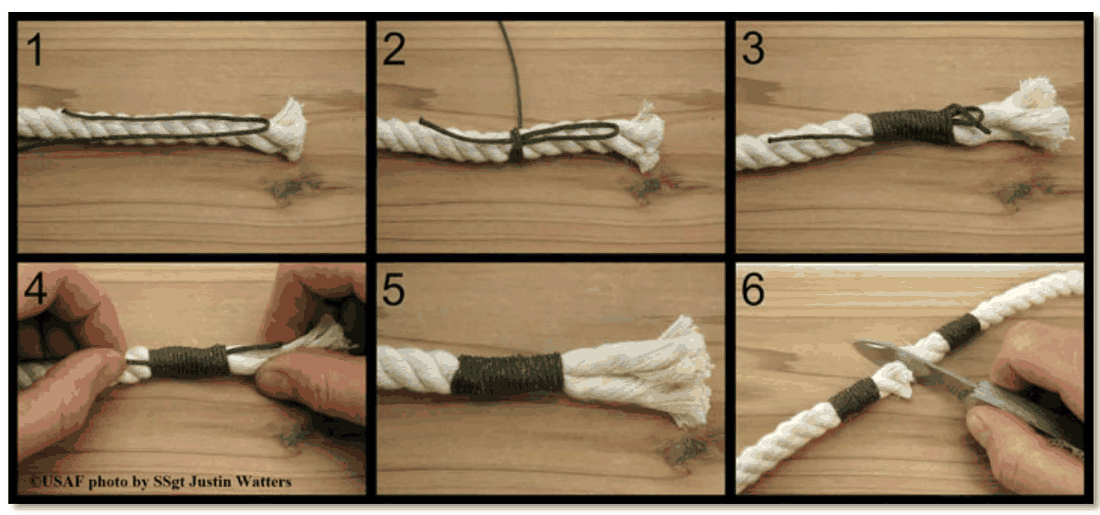 Whipping an end, and (6) whipping twice before cutting (AFH 10-644, p. 261).
Wrap about as long as the rope is thick (Rope on the Farm, p. 6). Before cutting, whip twice 1–2 inches apart and cut between (FM 5-125, p. 42). Synthetic rope: melt only the cut end (TC 3-97.61, p. 209).
Short splice
Joins two ropes of the same size for good; it's fatter than the rope, so not for pulleys (Rope on the Farm, p. 7; steps; Rope splicing). Open strands with a smooth, tapered hardwood pin about a foot long (p. 6).
- Untwist each end several turns; tape each strand end.
- Push the ends together so each strand lies between two strands of the other rope.
- Working across the twist, take each strand over its neighbour and under the next. Do the same from the other rope.
- Tuck every strand at least twice more. Trim, and roll the splice underfoot to even it.
If two strands go under one, redo them (p. 6). For pulleys, use the slimmer long splice (steps).
Eye splice
"As a permanent loop or eye, no knot can compare with this splice" (FM 5-125, p. 70; steps; Eye splice).
- Untwist the end 5 or 6 turns (put it through any ring now).
- Bend it back to the eye size. Tuck the middle strand under the nearest strand of the rope, against the twist.
- Take the next strand over that one and under the next.
- Turn it over; tuck the last strand under the remaining one. The ends now stick out evenly round the rope.
- Tuck each at least twice more, over one, under one (Rope on the Farm, p. 11).
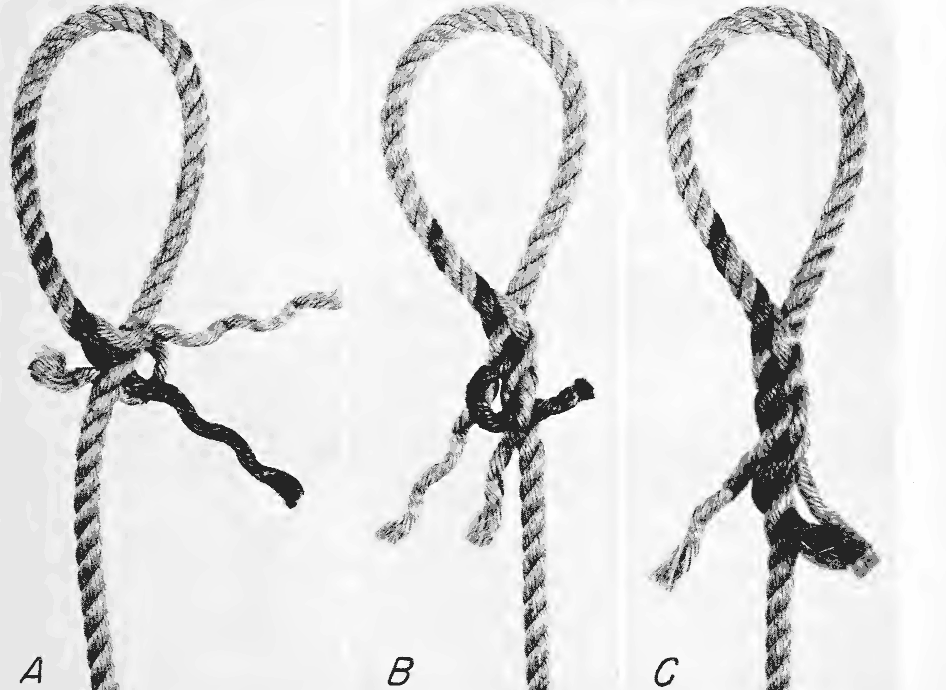 First tuck (A), second (B), and the finished splice (C) (Rope on the Farm, p. 11).
A metal thimble inside the eye saves wear (FM 5-125, p. 70).
How strong is a rope?
Working load and breaking strength
Breaking strength is the pull that parts it; the safe working load is "considerably less" (Navy Construction Electrician, p. 12). Safe load = breaking strength ÷ a safety factor: a new 1-inch manila rope breaks at 9,000 lb, so with a factor of 4 it may carry 2,250 lb. With no table, safe tons = (diameter in inches)², which allows a factor of about 4 (FM 5-125, p. 20).
| Rope | Safety factor (Navy, p. 12) |
|---|---|
| New | 4 |
| Used, in good shape | 6 |
| Worked hard: pulleys, daily use | 8 |
The factor should "NEVER be less than 3" (same page). Jerks, knots and sharp bends can cut strength "as much as 50 percent" (FM 5-125, p. 20). Nylon is nearly three times as strong as manila (p. 19); cotton is "not satisfactory for general farm use" (Rope on the Farm, p. 4).
Knots weaken rope
| Knot | Strength left (TC 3-97.61, p. 177, nylon) |
|---|---|
| Figure eight | 75–80% |
| Bowline | 70–75% |
| Two half hitches | 60–70% |
| Clove hitch, overhand | 60–65% |
A plain overhand knot cuts a straight rope's strength by 55% (FM 5-125, p. 44). A pulley block for fiber rope should be about 8 times as long as the rope is thick (Rope on the Farm, p. 11).
Wet, rotten and sun-damaged rope
- Wet: natural rope shrinks — slacken lines before rain. Frozen: thaw it fully first, or "the frozen fibers will break". Heat or boiling water cuts strength about 20% (FM 5-125, p. 21). Wet nylon loses little (Navy, p. 13).
- Sun: keep natural rope out of it (Rope on the Farm, p. 12); months of sun weaken nylon (TC 3-97.61, p. 209).
- Chemicals: acids, drying oils, fumes, paint and linseed oil (Rope on the Farm, pp. 4, 12), lime (Navy, p. 12) and petroleum (TC 3-97.61, p. 210).
- Rot hides inside. Untwist the strands and look: mildewed rope smells musty, its inner fibers dark and stained; sawdust-like powder means chafing. Pull two fibers — sound ones resist breaking. Cut bad rope into short pieces so no one hoists with it (FM 5-125, pp. 22–23).
Safe around a loaded rope
- Never stand in a bight or a coil of rope that is running or about to take a load, never step across a loaded rope, and stand aside from its line of pull (rule of thumb): overloaded rope breaks "with ... serious injury to personnel" (FM 5-125, p. 22), and stretchy nylon snaps back.
- Never wrap rope round your hand or body, and keep slack away from your feet (4-H PNW 587, p. 51).
- Never hold a hanging weight by hand alone: "always take a turn around some object", and "keep what they gain" (Mounted Instruction, p. 222).
- Steady a raised load with a guy rope, and pad sharp edges with sacking or wood (Mounted Instruction, p. 218): "Rope is cut more easily when under tension" (TC 3-97.61, p. 209).
- Slings: the wider the legs spread, the harder each is pulled — "stay above the critical angle" (FM 5-125, pp. 100–102; sling angles).
Lifting and hauling: block and tackle
- Count the ropes holding up the moving block (the one on the load): three ropes, 3 to 1. Count the pulling end too if it leaves from the moving block (FM 5-125, p. 110; simple tackles; Block and tackle).
- A pulley tied to a tree only turns the rope, "without affecting" the advantage (FM 5-125, p. 106). Two tackles in a row multiply: 4:1 on 4:1 gives 16:1 (p. 111).
- You pay in rope: at 5:1 you pull 5 ft for each foot the load moves; use the least advantage that will do (TC 3-97.61, p. 323).
- Friction: about 10% of the load per pulley. 5,000 lb on a 4:1 over four pulleys needs (5,000 + 2,000) ÷ 4 = 1,750 lb of pull (FM 5-125, pp. 114–115).
- People: about 100 lb each pulling down, 60 lb each pulling sideways, but more people fit along a level line; lead the rope out through a pulley (FM 5-125, p. 115).
- Hold what you gain with a prusik on the load rope (TC 3-97.61, p. 324). No pulleys? A trucker's hitch pulls with rope alone: the Army calls it "a two-to-one mechanical advantage" (FM 25-7, p. 156). Rope dragging on rope eats much of it, so count on less than the arithmetic says (rule of thumb).
- Anchors: a stake 3 inches thick and 5 ft long, driven 3 ft and leaning 15° away from the pull, holds about 700 lb in loamy soil; two lashed together, about 1,400 lb (FM 5-125, pp. 125–126; lashing two stakes).
Caring for rope
- New coil: pull the end up through the middle, unwinding counterclockwise (FM 5-125, p. 22).
- Kinks: unwind them, don't pull them out (Rope on the Farm, p. 12). Coil ordinary rope clockwise; to clear kinks, coil it counterclockwise and pull the bottom end up through the middle (Navy, p. 12).
- Grit cuts fibers: don't drag rope through sand or dirt (FM 5-125, p. 21).
- Dry before storing, or it gets dry rot (Rope on the Farm, p. 14). Hang it in the shade to dry (p. 12), in loose loops, never by heat (TC 3-97.61, p. 209).
- Store it airy: loose coils on wooden pegs or slats 6 inches off the floor, dry and unheated, away from chemicals (Navy, p. 12). Unused rope: uncoil, dry and stretch it every six months (Mounted Instruction, p. 218).
- Look over every foot of it regularly (Navy, p. 11), and keep a life rope for that only (TC 3-97.61, p. 210). To carry it, a butterfly coil is quickest (drawing).
Making cordage from plants and hide
Plant fiber, in short. Pull it, twist it, then tie an overhand knot: "If the knot does not break, the material is usable" (FM 3-05.70, p. 201; making lines). Try inner bark of linden, elm, hickory, white oak, mulberry or cedar (same page), dogbane stems cut in autumn (NRCS dogbane guide, p. 3; poisonous to eat and to stock, pp. 1–2), or mature nettle stems (OSU EM 9373, p. 1). Twist even strands clockwise, then lay two or three together counterclockwise so they lock (AFH 10-644, p. 274; the twists). A one-inch bark rope may hold 200–1,500 lb: "the lowest figure should always be regarded as the tensile strength" (p. 273). Retting nettle and spinning: Clothing & Leather, "Linen, nettle and native fibers". More, with the valley's own plants: Skills of the Valley's First Peoples ("Fibers, cordage and nets").
From animals (FM 3-05.70, pp. 201–202):
- Sinew for small lashings: dry deer tendons, smash them into fibers, moisten and twist. It needs no knots and hardens as it dries.
- Rawhide strips for big ones: cut the dry, cleaned hide into one ¼-inch strip spiralling out from the middle, soak it 2–4 hours, and stretch it on wet; it dries hard and tight. Making rawhide: Clothing & Leather, "Tanning hides".
Tying out animals and lashing loads
Tying an animal (4-H PNW 587, pp. 51–52; quick-release knot; Halter hitch):
- A quick-release knot on the lead, about 3 ft of rope, no lower than the withers, to a post set in the ground — not a fence rail. Never by the reins, never with a chain.
- Round the neck, a bowline: "Never use a slip knot around the horse's neck." A tightening knot can choke a struggling animal (Where There Is No Animal Doctor, p. 35).
A rope halter for a horse or cow: 14 ft of ½- or ⅝-inch three-strand rope, a tuck splice 18–22 inches from one end, and an eye splice in the short end (Rope on the Farm, p. 16; drawing).
Picket lines: a rope stretched tight on the ground between two pins, or 4–5 ft up between trees, tightened with a trucker's hitch. Tie animals 24 inches apart, alternate sides, short enough that they can't get a leg over (FM 25-7, pp. 155–156).
Pack and cart loads: balance the load, keep ropes away from the animal's feet and legs, and make every part as tight as possible (FM 25-7, p. 66). Cinch cart loads with trucker's hitches. Pack saddles and the diamond hitch: Horses. Carts, trailers and packboards: Bicycles & Carts.
⚠️ Old advice in the library to ignore
| Book says | Do this instead |
|---|---|
| Square knot for ropes "under a heavy strain", with "a tapered metal or wood rod through the center" (Rope on the Farm, p. 10); it "Never slips or jams" (1911 Scout handbook, p. 78) | It "will not hold if the ropes are wet or if they are of different sizes" (FM 5-125, p. 46). Use a double sheet bend |
| Blackwall hitch: "apply the load ... so that the rope jams firmly on the hook" (Rope on the Farm, p. 15) | "Human life and breakable equipment should never be entrusted to the blackwall hitch" (FM 5-125, pp. 62–63). Use an eye splice or a cat's-paw (p. 53) |
| Bowline "Used in lowering a person from a burning building" (1911 Scout handbook, p. 78); the bowline on a bight "is the sling for hoisting a man" (Kephart, p. 291) | The figure eight has replaced it for rescue: stronger, easier to check (FM 3-05.70, pp. 646–647) |
| Safe load "one-third to one-half the breaking weight" (Mounted Instruction, p. 218) | A quarter for new rope, an eighth for hard-used rope (Navy, p. 12) |
| Two half hitches "will not slip under any strain" (1911 Scout handbook, p. 79) | A half hitch "is not a very secure knot" (AFH 10-644, p. 267). For a load, a round turn and two half hitches |
| The clove hitch "will not slip on itself nor along the pole" (Kephart, p. 282) | "Tension must remain on the knot or it will slip" (FM 3-05.70, p. 643) |
| A running noose with a stopper, "a simple way of picketing a horse" (Kephart, pp. 289–290) | Only a bowline round an animal's neck (4-H PNW 587, p. 51) |
| "A whip tackle doubles the power" (Mounted Instruction, p. 222) | Only if the pulley rides on the load; one tied to a beam just turns the rope (FM 5-125, p. 106) |
Pictures & diagrams
Look before you try it. 🖼️ = drawings in the books on this drive; the other links are photos in the offline Wikipedia.
- Rope words, the parts of a knot — FM 5-125, p. 41
- Square, granny and thief knots — AFH 10-644, p. 263; FM 5-125, p. 48; Square knot; Granny knot
- Bowline — FM 5-125, p. 50; AFH 10-644, p. 265; 1911 Scout handbook, p. 78; Bowline
- Sheet bend — FM 5-125, p. 48; AFH 10-644, p. 264; Rope on the Farm, p. 13; Sheet bend
- Clove hitch — FM 5-125, p. 62; TC 3-97.61, p. 200; FM 3-05.70, p. 644; Clove hitch
- Half hitches, round turn — FM 5-125, p. 60; AFH 10-644, p. 269; Round turn and two half-hitches
- Rolling hitch (taut-line) — FM 5-125, p. 63; Kephart's magnus hitch, p. 280; Taut-line hitch
- Trucker's hitch: the sheepshank loop; the baker bowline, its cousin for cargo — FM 5-125, p. 66; p. 57; Trucker's hitch
- Timber hitch — FM 5-125, p. 61; AFH 10-644, p. 268; Rope on the Farm, p. 14; Timber hitch
- Figure eight and its loop — FM 5-125, p. 45; TC 3-97.61, p. 180; FM 3-05.70, p. 647; Figure-eight knot
- Prusik — TC 3-97.61, p. 195; FM 3-05.70, p. 646; AFH 10-644, p. 457; Prusik
- Square, shear and tripod lashings — FM 5-125, p. 68; AFH 10-644, p. 271; p. 272; FM 3-05.70, p. 648; p. 649
- Whipping; short, long, eye and crown splices — AFH 10-644, p. 261; Rope on the Farm, p. 7; p. 8; p. 11; p. 12; FM 5-125, p. 71; Eye splice
- Block and tackle — FM 5-125, p. 107; p. 112; TC 3-97.61, p. 325; Rope on the Farm, p. 15; Block and tackle
- Sling angles; stake anchors — FM 5-125, p. 105; p. 125; p. 127
- Coiling rope — FM 5-125, p. 22; TC 3-97.61, p. 211; Rope
- Tying a horse; a rope halter — 4-H PNW 587, p. 51; p. 52; Rope on the Farm, p. 16; Halter hitch
- Twisting cord; dogbane — AFH 10-644, p. 275; NRCS dogbane guide, p. 1; Apocynum cannabinum; Rawhide
Related guides
- Illinois Valley — Start Here — the local picture and where everything is on the drive
- Horses — tying up, "Travel and packing" (pack saddles, the diamond hitch), harness
- Bicycles & Carts — loading and lashing trailers, handcarts and packboards
- Clothing & Leather — "Linen, nettle and native fibers", "Tanning hides" (rawhide)
- Firewood — felling and moving logs
- Shelter & Building — poles, frames and raising heavy pieces
- Hunting, Trapping & Fishing — snares, nets and fishing knots
- Water Wells — rope pumps and windlasses
- Make-Do Household — mending and making what you need